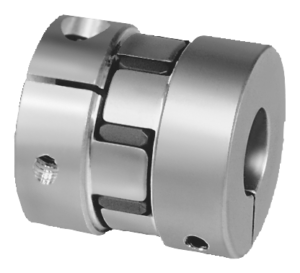
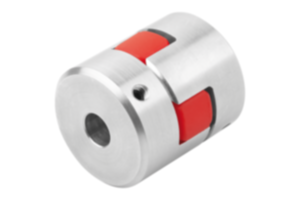
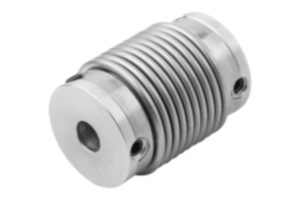
Elastomer dog coupling with conical hub and shaft collar aluminum 23021-10-19920661214
- Play-free elastomer coupling clamp with grub screw
- For shaft diameters from 6 to 60 mm
- Torque range: 4 - 525 Nm
- Compensation of misalignments (axial, radial, angular)
- Axially attachment, thus very simple installation
Sales unit
$249.41 / Piece
plus sales tax
Added to Your Shopping Cart
Designation
Elastomer dog coupling
Version 1
with conical hub and shaft collar
Main
material
aluminum
Component
material
polyurethane
Component
color
yellow
L=Length
66
C
(ISO 4029)
M4
Coupling spider
hardness
92 Shore A
D1
(H7)
12
D1/D2
max.
20
D1/D2
min.
10
D2
(H7)
14
D4
40
L1
25
L2
16
Max.
torque
Nm
24
Moment of inertia
(gm²)
0,066
Nom. torque
Nm
12
Size
19
Spring stiffness
radial
(N/mm)
1120
Tightening
torque of
screws Nm
2,9
Torsional stiffness
static
(Nm/wheel)
1090
Torsional stiffness
dynamic
Nm/wheel
1815
max.
rpm
19000
max.
angular offset
(°)
1
max. shaft offset
axial
(mm)
+1,2 / -0,5
max. shaft offset
radial
(mm)
0,1
~ CONFLICT MINERALS 3TG status
not yet identified
~ CP65 substance 2 cancer
soots, tars, and mineral oils
~ PFAS free?
not yet identified
~ REACH SVHC-free?
yes
~ RoHS conformity
yes, without exemption
~ TSCA 6(H) conformity
yes
Description
Material
Hub aluminum.
Conical ring steel
Coupling spider polyurethane.
Conical ring steel
Coupling spider polyurethane.
Version
Hub bright.
Coupling spider blue Shore 80A.
Coupling spider yellow Shore 92A.
Coupling spider red Shore 98A.
Coupling spider blue Shore 80A.
Coupling spider yellow Shore 92A.
Coupling spider red Shore 98A.
Note
Elastomer dog coupling consisting of two hubs and an elastomer coupling spider. They are suitable for compensating axial, radial and angular misalignments and for cushioning vibrations and torque shocks.
The polyurethane coupling spiders are available in various hardness grades. As the hardness of the coupling spider increases, the torque and stiffness transmitted increases, and as the hardness decreases, the displacement capacity and cushioning increases.
Pre-tensioning of the spiders in the coupling hubs make this variant play-free.
Supplied unassembled.
Technical Data
-
Temperature range
Blue Shore 80A: -50 °C to +80 °C. Briefly -60 °C to +120 °C.
Yellow Shore 92A: -30 °C to +90 °C. Briefly -50 °C to +120 °C.
Red Shore 98A: -30 °C to +90 °C. Briefly -40 °C to +120 °C.
Yellow Shore 92A: -30 °C to +90 °C. Briefly -50 °C to +120 °C.
Red Shore 98A: -30 °C to +90 °C. Briefly -40 °C to +120 °C.
Assembly
The elastomer dog couplings have an H7 tolerance. The recommended clearance tolerance is 0.02 - 0.05 mm. This tolerance and lubricating the shaft journals aids assembly and removal.
For installation, the hubs of the elastomer dog coupling are simply pushed onto the shafts. Set to the correct axial position and, using a torque wrench, tighten the clamping screws to the torque indicated in the table. To increase the misalignment compensation of the coupling and the service life of the spider, the dimension L2 should be observed.
For installation, the hubs of the elastomer dog coupling are simply pushed onto the shafts. Set to the correct axial position and, using a torque wrench, tighten the clamping screws to the torque indicated in the table. To increase the misalignment compensation of the coupling and the service life of the spider, the dimension L2 should be observed.
On request
Hub bores D1 and D2 with separate tolerance class or range.
Important note on downloading CAD models
In order to download our CAD models, you must log in first. If you have not created an account yet, please register under "My Account" (right side of the screen) and follow the instructions.
Other customers also bought